Constructing Dynamic S-boxes Based on Chaos and Irreducible Polynomials for Image Encryption
Nonlinear Dynamics(Springer,JCR Q1,IF 6.0), 2024
abstract
Substitution boxes (S-boxes) lie at the heart of modern symmetric ciphers, and the cryptographic
strength of a cipher depends heavily on the nonlinearity, differential uniformity, and
unpredictability of its S-box. Static S-boxes, however, are vulnerable to algebraic and
side-channel attacks once their structure is fixed. This work proposes a dynamic S-box
construction scheme that combines a two-dimensional chaotic map with irreducible polynomials
over the finite field
The chaotic map provides key-dependent sensitivity and a vast parameter space, so that each key
induces a distinct S-box; irreducible polynomials over
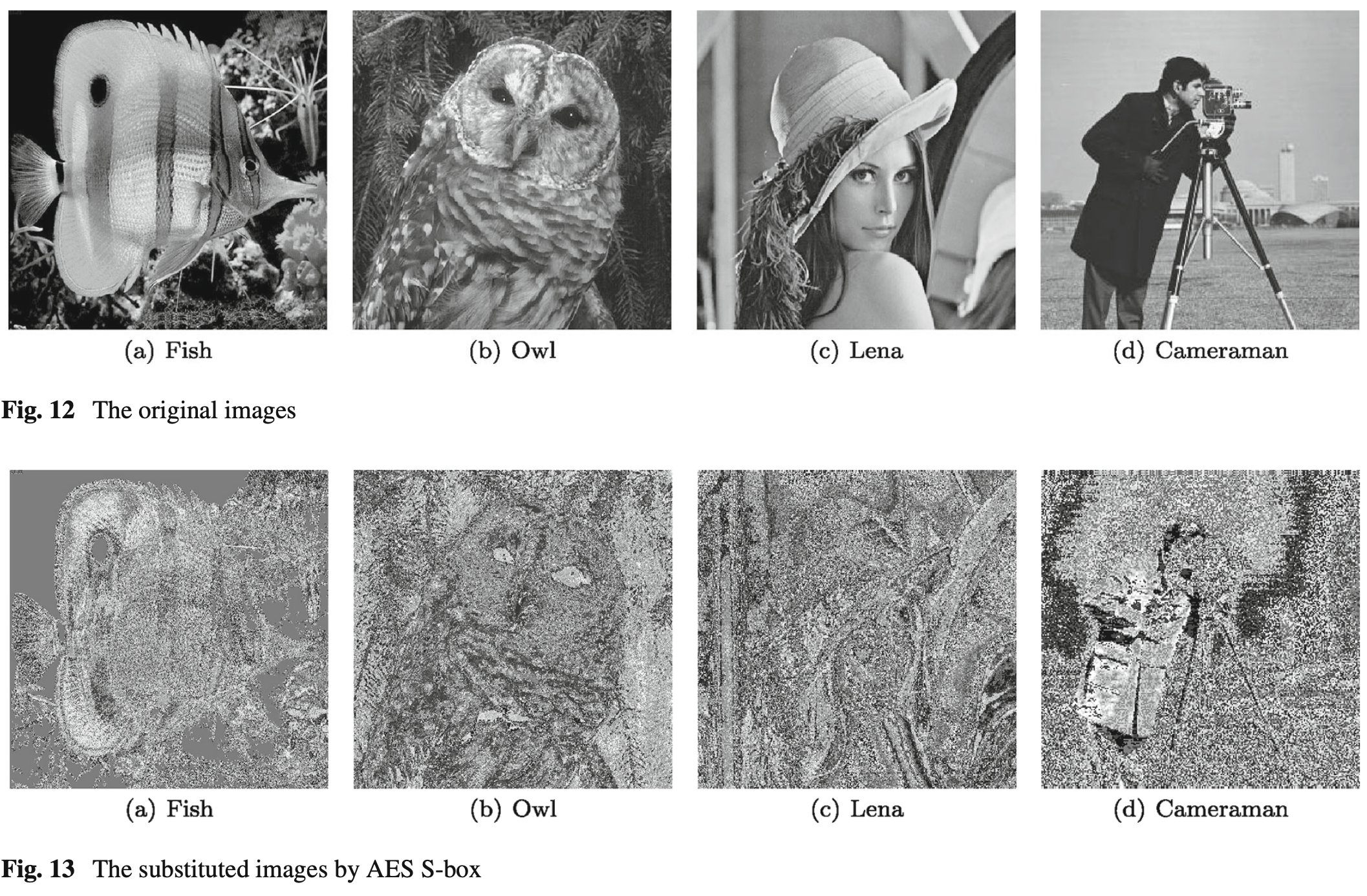
We further integrate the dynamic S-box into a block-cipher image encryption pipeline, and show on standard test images that it delivers strong pixel-level confusion and diffusion, near-uniform ciphertext histograms, high NPCR/UACI scores against plaintext-sensitivity attacks, and robust resistance to differential, statistical, and brute-force attacks.
Background
Symmetric ciphers rely on S-boxes to provide the confusion layer that resists linear and differential cryptanalysis. A static, key-independent S-box leaks the same algebraic structure across every ciphertext it produces, so once the structure is known it becomes the natural attack surface.
What this paper proposes
- Chaos-driven keying. A 2-D chaotic map is used to produce, for every key, a fresh S-box. Sensitivity to initial conditions means a small change in the key yields a structurally different S-box.
- Algebraic anchoring in
. Candidate S-boxes are built from irreducible polynomials over , which bounds the worst-case nonlinearity and differential uniformity so that every instance meets the cryptographic criteria. - Standard-battery evaluation. Ablations on nonlinearity, SAC, BIC, and differential/linear approximation probability, plus generation-cost measurements.
- Image-encryption pipeline. The dynamic S-box is dropped into a block-cipher image encryptor and evaluated on standard test images: near-uniform histograms, high NPCR/UACI, and resistance to differential / statistical / brute-force attacks.
Figure