TouchBridge: Multi-Bridge Alignment and Reversible Canonical Tactile Space for Cross-Sensor Robotic Manipulation
ICRA 2026, Submitted, 2025
abstract
Optical tactile sensors differ widely in geometry, illumination, and readout, so a representation or policy learned on one sensor rarely transfers to another. This forces practitioners to re-collect data and re-train for every new fingertip. TouchBridge addresses this with a reversible canonical tactile space: a shared latent that any sensor can be mapped into and, crucially, mapped back out of, so tactile signals can be translated across heterogeneous sensors rather than merely embedded.
Alignment is learned through multi-bridge alignment — instead of one monolithic encoder, each sensor connects to the canonical space through its own invertible bridge, and the bridges are trained jointly so that the canonical space stays sensor-agnostic while remaining decodable back to each native sensor domain. This lets a manipulation policy or representation trained on one sensor operate on another with little or no new tactile data.
We evaluate on cross-sensor manipulation, transferring tactile representations and contact-driven control across sensors, and show that the reversible canonical space preserves the contact information needed for downstream manipulation while enabling sensor-to-sensor translation.
Motivation
An optical tactile image is not a natural photograph — it’s a physical contact event rendered through a specific sensor’s gel, illumination, and marker layout. The same press, slide, or load change looks completely different once it passes through a different sensor’s optics and calibration. This rendering gap is why cross-sensor tactile learning can’t just mean “use a bigger shared encoder”: a large enough encoder will happily learn to recognize which sensor produced an image before it learns what contact happened, and a representation built that way is stuck on the sensor it was trained on.
Bridges: what prior work actually aligns on
We found it useful to describe existing cross-sensor tactile methods by what supervision they use to pin heterogeneous observations to the same underlying contact — a bridge. Four kinds show up in the literature, each strong somewhere and narrow somewhere else:
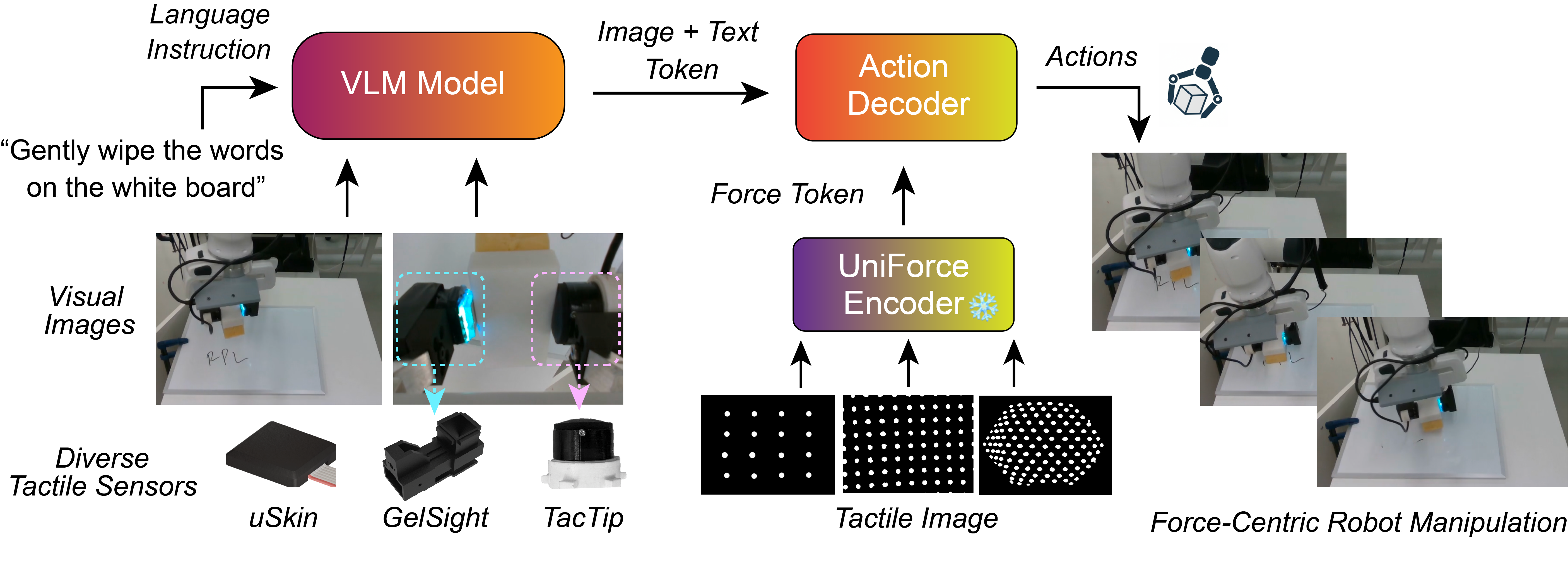
- Force bridges (e.g. UniForce) press two sensors under matching quasi-static force equilibrium, so the physics — not sensor appearance — guarantees the pair corresponds to the same contact. This gives a strong physical anchor, but a low-dimensional one: it says little about contact events or object semantics, and it depends on the indentation staying quasi-static.
- Task-label bridges (T3, UniT, Sparsh, AnyTouch/AnyTouch2) put many sensors through one shared encoder trained on material, slip, pose, or reconstruction objectives. This scales across datasets, but the resulting representation is usually discriminative and one-directional — you can read off a label, but you can’t ask what a different sensor would have seen.
- Cross-modal bridges (UniTouch, TVL/TLV-CoRe) align touch with vision, language, or audio, which is exactly what lets a model connect touch to high-level semantics like “hammer” vs. “apple.” Semantic alignment isn’t the same thing as sensor disentanglement, though — an embedding can be retrievable by text and still carry a strong sensor-specific signature.
- Translation bridges (Touch2Touch, GenForce) map one sensor’s appearance directly onto another’s, which is the closest existing idea to reversibility. In practice this tends to mean training a new translator per sensor pair, so it doesn’t scale combinatorially and the translated data usually has to be fed back into a fresh downstream model.
A portfolio of bridges, not one
TouchBridge’s position is that none of these bridges is wrong, they’re just individually narrow — so instead of betting on one, we let force and delta-force, contact geometry, discrete actions, load sequences, simulator-shared state, and cross-sensor pairing supervise the same space jointly, weighted by how reliable each signal actually is.
That shared space, which we call TacCanon, is defined by what it excludes rather than what it contains: the only thing pushed out is sensor identity. Everything sensors have in common — force and contact dynamics, actions and events, object and material semantics, anything alignable across modalities — is kept. Because identity is factored out into its own swappable component instead of discarded, the same contact content can be re-rendered as if any target sensor had observed it: cross-sensor transfer becomes translation through a shared space, not a one-way embedding, and it doesn’t require training a new bridge per sensor pair.
Results
Evaluated across three optical tactile sensors (GelSight, GelSight Mini, DIGIT) and nine public datasets, TouchBridge’s canonical representation reaches 77.0% on the TAG material-recognition benchmark and 42.3% on Cloth — both state of the art among the methods we compare against — with 86.7 and 98.0 F1 on slip detection across two evaluation settings. On real-robot manipulation, policies built on top of the canonical representation reach 0.80 grasping, 0.85 wiping, and 0.85 chip-relocation success, outperforming both single-sensor baselines and encoders trained without cross-sensor alignment.
Why reversibility matters downstream
Because TacCanon is sensor-agnostic by construction, a manipulation policy sitting on top of it never needs to know which sensor produced its input — swapping a fingertip becomes a matter of re-fitting a small identity component, not retraining the policy.